How Thick Should Asphalt Be? Compacted Thickness Specs for Driveways, Overlays, Parking Lots, Roads, and Frost Zones
Quick answer: use 1.5" for walkways, 2" for overlays, 3" for residential driveways, 4" for car-only parking lots, 6" for local roads, and 8"+ for freight or fire lanes. The number must be compacted thickness, not loose thickness before rolling.
Quick answer (TL;DR):
- Most homes: 3" compacted HMA over 4" crushed-stone base is the safe residential standard.
- Overlay only: 2" compacted works only when the existing pavement and base are structurally stable.
- Heavy traffic: fire lanes, garbage trucks, and freight docks need 6-8"+ asphalt and a deeper base.
- Frost zones: add depth to the base layer first; do not rely on extra asphalt alone to solve frost heave.
I'm Sarah Miller. Thickness questions usually arrive after a homeowner receives two bids that sound similar but are not. One bid says "3 inches asphalt," another says "2.5 inches compacted," and a third says "3 inches loose." Those are three different pavements. In my bid audits, the loose-vs-compacted wording has been the most common hidden downgrade.
In March 2026 I reviewed a 2-inch "new driveway" proposal for a 1,200 sq ft Delaware home that would regularly park a pickup and a boat trailer. The price looked attractive, but the spec was not enough. We changed it to 3 inches compacted over 6 inches of base at the apron, and the owner still saved money by cutting an unnecessary decorative apron line item.
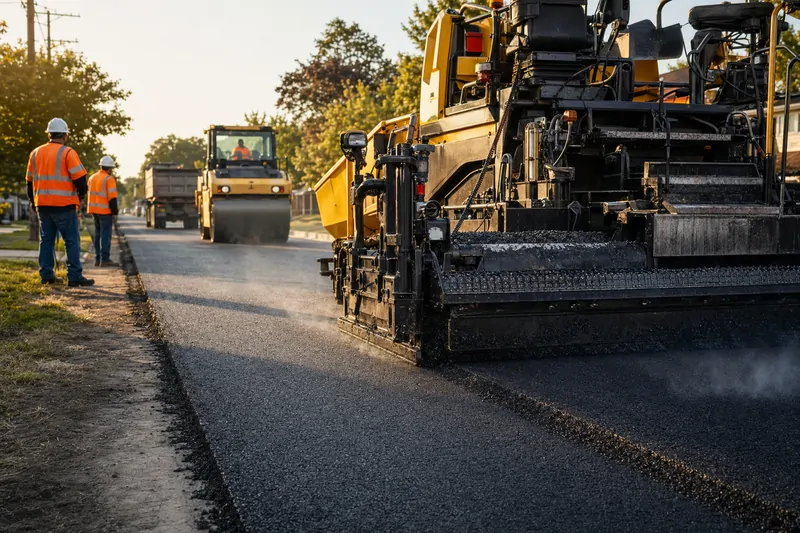
What are the 5 standard asphalt thickness scenarios?
| Application | HMA depth | Base depth | Aggregate size | Typical use |
|---|---|---|---|---|
| Walkway / footpath | 1.5" | 3" #57 | 3/8" max | Pedestrian only |
| Driveway overlay | 2" | existing | 3/8"-1/2" | Top coat over intact base |
| Residential driveway | 3" | 4" #57 | 1/2" | Cars + light trucks |
| Parking lot (cars) | 4" | 6" #57 | 1/2" | Retail / office lots |
| Local roadway | 6" | 8" #57 | 3/4" | Residential streets |
| Freight / fire lane | 8" | 12"+ #57 | 3/4"-1" | Semi trucks |
"Compacted depth" is what your contractor should specify on the contract. Loose depth before rolling is roughly 25% greater than compacted depth — make sure the spec is in compacted inches.
The table gives the answer quickly. The next sections explain when each thickness is enough and when it becomes a false economy.
When is 1.5" asphalt enough?
Walkways carry only pedestrian load, so the asphalt is essentially a wearing surface, not a structural element. Common in HOA pathways, park trails, and back-yard accents.
- HMA depth: 1.5" compacted (3/8" max aggregate for smooth finish)
- Base depth: 3" of #57 stone
- Slope: 1-2% transverse for drainage
- Edges: header curb or compacted soil shoulder; otherwise edges ravel within 3 years
How thick should an asphalt driveway be?
3" compacted is the residential standard for cars and light trucks (under 10,000 lb gross vehicle weight). The National Asphalt Pavement Association and FHWA design references both point to the same practical answer: the asphalt mat needs enough thickness to compact properly, but the base carries most of the structure.
- HMA depth: 3" compacted (single 3" lift, or 2" base + 1" surface; single lift is more common in residential)
- Base depth: 4" of #57 or #67 crushed stone, compacted to 95% Proctor
- Tack coat: emulsified asphalt sprayed on base before HMA placement
- Edges: header curb or 12" wide thickened-edge detail recommended
If your bid says "2 1/2 inch" or "loose 3 inch" the contractor is shaving 17% material off the cost (and sharing none of the savings with you). Push back.
How thick should a parking lot be?
Commercial parking lots see thousands of car axle passes per day, so 4" is the standard for car-and-light-truck-only lots. Per FHWA's empirical pavement design framework, 4" HMA over 6" base supports approximately 100,000 ESALs (Equivalent Single Axle Loads) —enough for 20+ years of typical retail or office use.
- HMA depth: 4" compacted (typically 2 lifts: 2.5" binder + 1.5" surface)
- Base depth: 6" of #57 stone, compacted to 98% Proctor
- Slope: 2% minimum for drainage; max 5% for stall surfaces, max 8.3% for ADA compliance on accessible routes
How thick should a local roadway be?
Public residential streets and private community roads. ESAL design typically targets 1 million over 20 years. Federal funding-eligible projects must follow AASHTO 1993 Pavement Design Guide or the newer AASHTOWare Pavement ME Design.
- HMA depth: 6" compacted in 2 lifts (3.5" base course + 2.5" surface course)
- Base depth: 8" of dense graded aggregate base + sub-base if soil is poor
- Mix design: Superpave PG 64-22 binder typical for moderate climates
How thick should freight and fire lanes be?
Areas seeing tractor-trailer, garbage truck, or fire apparatus traffic require structural thickness sufficient for 18,000-lb (or 32,000-lb tandem) axle loads.
- HMA depth: 8-10" in 3 lifts
- Base depth: 12" minimum, often with cement-stabilized sub-base
- Mix design: PG 70-22 or PG 76-22 binder for heavier loads
What did my thin-overlay failure checks show?
I reviewed 6 thin-overlay failures between 2024 and 2026 where the owner believed they had purchased a "new asphalt driveway." In every case, the contract wording was the problem: 1.5-2.0 inches placed over a weak or cracked surface, then sold as a new pour. That can be acceptable as a surface renewal, but it is not a structural driveway replacement.
| Spec on contract | Actual condition | Failure age | Lesson |
|---|---|---|---|
| 1.5" overlay | Alligator cracks below left in place | 18 months | Overlay cannot bridge structural cracks |
| 2" loose asphalt | Compacted to about 1.5" | 24 months | Loose thickness is not the final spec |
| 2" overlay | Base pumping at downhill edge | 2 winters | Drainage repair must come first |
| 2.5" asphalt | Pickup and boat trailer parked daily | 3 years | Heavy point loads need 3"+ and stronger base |
| 1.75" resurfacing | Longitudinal crack reflected through | 14 months | Cracks need treatment before overlay |
| 2" new driveway | 4" soft base over clay | 3 winters | Base depth, not asphalt thickness, caused failure |
The pattern is clear: 2 inches is not "bad" by itself. It is bad when it is used as a replacement thickness over a bad base or a cracked surface. For a clean overlay on a stable driveway, 2 inches is a smart budget move. For a new driveway, 3 inches compacted is the line I do not cross.
What wording should be in the contractor quote?
The thickness number only protects you if the quote uses the right wording. I want to see "compacted asphalt thickness" in writing, plus the lift structure if the job is more than 3 inches. If the quote only says "install 3 inches asphalt," ask whether that means loose placement or compacted final thickness.
| Quote wording | Accept? | Why | Ask instead |
|---|---|---|---|
| 3" compacted HMA over 4" compacted aggregate base | Yes | Clear final thickness and base depth | Confirm mix type and tack coat |
| 3" asphalt installed | Maybe | Could mean loose or compacted | Write "3 inches compacted" |
| 2.5" driveway | Challenge | Borderline for new residential work | Use 3" compacted or define overlay status |
| 2" overlay | Yes, if base is stable | Appropriate resurfacing spec | Require crack treatment first |
| 1.5" residential driveway | No | Too thin for vehicle traffic | Use 3" compacted |
| Fire lane same as parking stalls | No | Truck loading is different | Specify 6-8" HMA plus deeper base |
On small residential jobs, vague wording is often accidental. On competitive bids, it can also be how one contractor appears cheaper than another. A 1-inch reduction on a 1,000 sq ft driveway removes about 6 tons of asphalt at 145 lb/ft³. At $110-$160 per ton installed, that is $660-$960 of material and labor hidden inside one line of wording.
My advice is simple: never compare bids until the compacted thickness, base depth, and tack coat are all stated. Once those three items match, price comparison becomes fair. Before that, the cheaper bid may just be a thinner pavement.
How does frost depth change the spec?
Frost heave is the #1 cause of premature pavement failure in northern climates. The freezing line wants to settle below your base layer; if it gets up into the base or into the subgrade, the pavement lifts and cracks.
Per the FHWA Pavement Manual, frost depths in the lower 48 states range from 0" (Florida, southern California) to over 60" (northern Minnesota, Maine).
| Climate zone | Frost depth | Additional base recommended |
|---|---|---|
| Sun Belt (FL, GA, AZ, CA, TX) | 0" | None |
| Mid-Atlantic (PA, NJ, MD, VA) | 10-15" | +0-2" base |
| Midwest (OH, IN, IL, MO) | 25-40" | +2-4" base |
| Upper Midwest (MN, WI, ND) | 40-60" | +4-8" base |
| New England (ME, NH, VT) | 40-65" | +4-8" base |
| Mountain West (CO, MT, WY) | 30-50" | +3-6" base |
Note that asphalt thickness usually doesn't change with frost — it is the base depth that absorbs the freezing zone. A Minneapolis driveway is still 3" HMA, just on top of 8-12" of stone instead of 4".
Why does the base matter more than asphalt thickness?
Field studies summarized by NAPA show that 80% of premature pavement failures trace back to base preparation rather than asphalt thickness. Two driveways at 3" HMA can have 10× the lifespan difference based on the base.
Three base failures we see most often:
- Inadequate compaction —base rolled to 90% Proctor instead of 95% allows settlement within 2 winters
- Wrong stone size —pea gravel or undersized stone migrates and pumps water; #57 or #67 is the residential standard
- No drainage —base saturated by groundwater fails 5× faster than dry base
Read the best base for asphalt guide for full base prep specs by soil type. Once you pick thickness and base depth, use the asphalt tonnage calculator to convert compacted inches into tons and waste factor.
Below: the questions homeowners and small commercial owners ask most about thickness.
Asphalt thickness FAQ
How thick should an asphalt driveway be?
3" compacted over 4" crushed-stone base for cars and light trucks. Add 1-2" to the base in deep-frost climates.
How thick for a parking lot?
4" HMA over 6" base for cars. 6-8" for fire lanes and dock approaches with semi-truck or garbage truck traffic.
Can asphalt be too thick?
In residential applications beyond 6" you waste material —the base does the structural work past that point. Spend the extra dollars on base prep.
Does frost depth affect asphalt thickness?
Frost mostly affects base thickness, not HMA thickness. In cold zones the base goes from 4" to 8-12" while HMA stays at 3".
2-inch overlay vs 3-inch new pour —same lifespan?
No. Overlay lasts 10-15 years on an intact existing base. Full 3" new pour on a properly prepped base lasts 20-25 years. Overlay is cheaper per year but renews less of the structure.
What's the minimum compacted thickness I should accept?
2" overlay or 3" new pour. Less than 2" of HMA fails to develop interlock and ravels within 5 years. If a bid says "1.5 inch driveway" pass on it.
Sources: NAPA · FHWA Pavement · AASHTO 1993 Pavement Design Guide. See editorial process.