Driveway Asphalt Calculator 2026: Residential Tons, 3-Inch Depth, Overlay, and Paving Cost
Pre-tuned for the residential 3-inch full-depth driveway spec (or 2-inch overlay) using NAPA's 145 lb/ft³ density. Get tons, cubic yards, and a 2026 USD/CAD/GBP project budget in one screen.
This page answers:
- How much asphalt do I need for my driveway (single-car or two-car)?
- Should I overlay or replace?
- What does it cost to pave a driveway in 2026?
Driveway calculator
What are the quick driveway sizing answers?
If you don't know your dimensions yet, here's the residential cheat sheet —defaults assume 3-inch full-depth and 5% waste:
I use this table as a first-pass sanity check before I trust any contractor quote. If your driveway lands far outside these tonnage ranges, recheck the measured width, the compacted depth, and whether the quote includes base reconstruction instead of asphalt alone. Small measurement errors compound fast on long rural drives today.
| Size | Dimensions | Tons | Cubic yards | 2026 cost (USD) |
|---|---|---|---|---|
| Compact car | 30 × 10 ft | ~3.4 | ~2.8 | $1,800—2,400 |
| Single car | 50 × 12 ft | ~6.8 | ~5.6 | $3,000—3,800 |
| Two car | 50 × 20 ft | ~11.4 | ~9.3 | $4,800—6,200 |
| Three car | 60 × 30 ft | ~20.5 | ~16.7 | $8,400—10,500 |
| Long rural drive | 200 × 12 ft | ~27.4 | ~22.2 | $11,500—14,500 |
Should I overlay my driveway or replace it?
This decision swings the budget by 40-60 percent. Use the rule below —when in doubt, get a paving contractor to do a free 10-minute site walk.
| Condition | 2" Overlay | Full replacement |
|---|---|---|
| Surface cracks < 1/4" wide | Yes | Optional |
| Alligator cracking > 30% surface | No | Yes |
| Base heaving / settlement | No | Yes |
| Existing thickness ≈2" | Yes | No |
| Drainage problems | No | Yes (regrade base) |
| 2026 cost (1,000 sq ft) | $2,500-$3,500 | $5,000-$8,500 |
What does proper driveway prep look like?
The base does 80 percent of the structural work. Skip the prep and your fresh pavement cracks within 2 winters. The standard residential build-up is:
- Sub-grade compaction —native soil graded for 1-2% slope and rolled to 95% Proctor density
- 4 inch crushed stone base —typically #57 or #67 stone, also rolled to density
- Tack coat —emulsified asphalt sprayed on base for bond
- 3 inch HMA wearing course —laid hot, rolled while still 175°F+
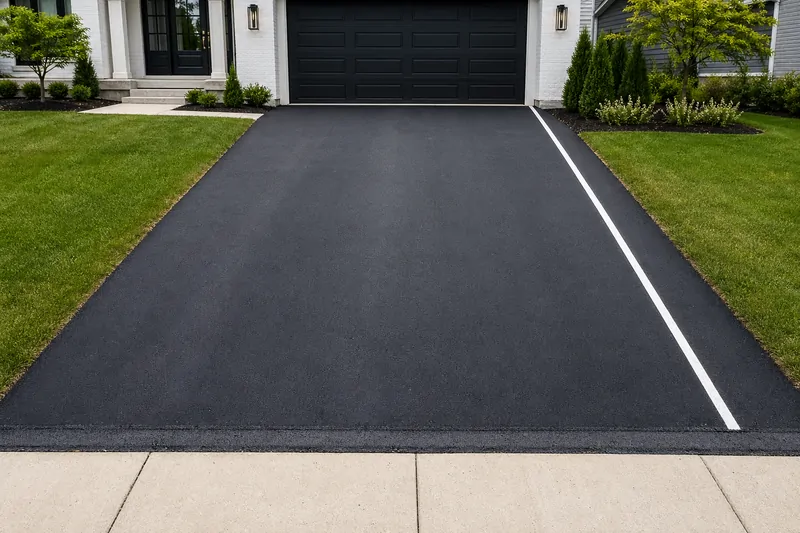
- Edge sealing —12 inch wide stripe at perimeter to prevent water intrusion
For deep-frost climates (Minnesota, Maine, etc.), increase the base to 6 inches. The base preparation guide covers soil-by-soil specifications.
Now the questions every homeowner asks before signing a contract.
Driveway calculator FAQ
How much asphalt do I need for a driveway?
50 × 12 ft single-car at 3" needs ~5.5 tons with 5% waste. 50 × 20 ft two-car needs ~9.2 tons. Use the calculator above for any size including L-shape and curved drives.
How thick should my asphalt driveway be?
3 inches over a 4-inch crushed stone base is standard for cars and light trucks. 2-inch overlay works on intact existing surfaces. Add 1 extra inch in deep-frost regions.
How much does an asphalt driveway cost in 2026?
$3,000-$5,500 for a single-car (600 sq ft) and $5,000-$8,500 for two-car (1,000 sq ft) installed nationwide. Add 20-40% in NE, NYC metro, and West Coast cities.
Should I overlay or replace?
Overlay if the existing base is intact and damage is surface only —saves 40-60%. Replace if alligator cracking covers more than 30% or the base has heaved.
How long does an asphalt driveway last?
15-25 years with sealing every 3-5 years. Without sealing, expect 12-15 years. See the asphalt lifespan guide for sealing schedules and crack-fill protocols.
Can I drive on a fresh asphalt driveway?
Wait 24 hours for foot traffic and 3 days for vehicle traffic. Avoid heavy loads (RVs, dumpsters) for 30 days. Power steering on a hot day can leave divots in the first 60 days.