Asphalt Calculator 2026: Tons, Cost, Cubic Yards, and Driveway Coverage
A free engineer-grade asphalt calculator and paving estimator that returns tons, cubic yards, square yards, and project cost the moment you finish typing — for driveways, parking lots, and roads. Use it to sanity-check contractor quotes or plan your own pour.
What you'll get below:
- Instant tonnage, volume, and cost for any rectangle, L-shape, triangle, or circle area
- Imperial or metric units with USD, CAD, or GBP pricing
- Printable estimate report you can share with three contractors
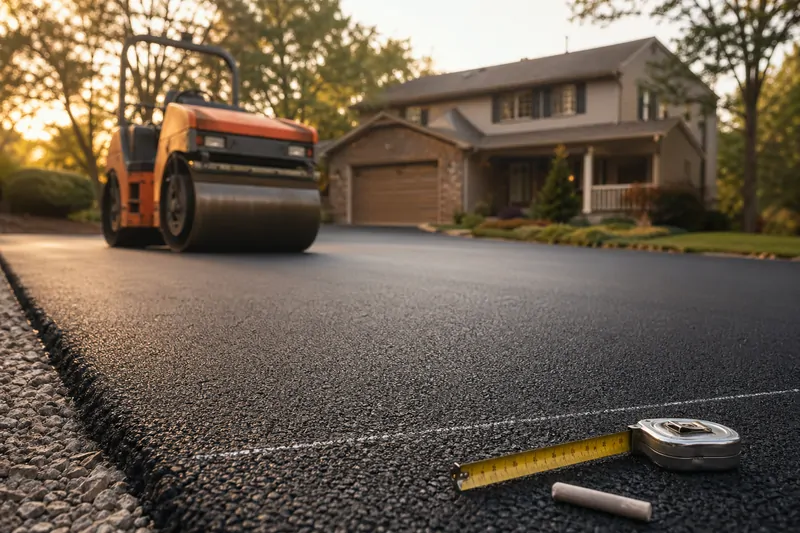
Asphalt calculator
How is asphalt tonnage calculated?
The math is fixed industry chemistry. Volume in cubic feet equals length times width times depth (with depth converted from inches by dividing by 12). Multiply that volume by your asphalt density, divide by 2,000 to get short tons, then add a waste factor of 5 to 10 percent for compaction loss and trim cuts.
| Quantity | Formula | Default Value | Source |
|---|---|---|---|
| Volume (ft³) | L × W × D | — | Geometric |
| Cubic Yards | Volume ÷ 27 | — | 1 yd³ = 27 ft³ |
| Tons | Volume × Density ÷ 2000 × (1 + Waste) | Density 145 lb/ft³ | NAPA published average |
| Cost | Tons × $/ton + Area × $/sf labor + hauling + compaction | $130/ton + $2.50/sf | 2026 US industry average |
| Waste factor | +5% to +10% | +5% (residential) | NAPA construction guideline |
Density of 145 lb/ft³ matches the National Asphalt Pavement Association (NAPA) average for hot mix asphalt. Local mixes vary 140 to 150 lb/ft³ — adjust the density slider in the calculator if your supplier provides a sheet.
Which asphalt project are you planning?
Each project type has its own thickness, density, and waste rule of thumb. Tap a card to jump to a specialized calculator pre-tuned for that scenario.
Asphalt for a driveway
3" full depth · 5% waste · 5-10 tons typical for a 50 × 12 ft drive.
CommercialAsphalt for a parking lot
4" full depth · 7% waste · plus striping coverage and ADA slope notes.
TonnageHow many tons do I need?
Pure weight calculator with sy ↔ tons conversion for purchase orders.
BudgetTotal project cost
USD / CAD / GBP material, labor, hauling and compaction breakdown.
What asphalt depth should you use?
Depth is the single most expensive variable in your estimate — every extra inch adds roughly 33 percent more material. Engineers pick depth from a small set of proven values rather than guessing:
- 1.5" — walkways, footpaths, light pedestrian areas (no vehicle load)
- 2" — driveway top coat over an existing 2" base (overlay only)
- 3" — full depth residential driveway (most common spec for cars and light trucks)
- 4" — commercial parking lot, light truck access, garbage truck zones
- 6"+ — public roadways, freight depots, anywhere with sustained heavy axle loads
If you live in a frost-prone climate, add a 4 to 6 inch crushed stone base under the asphalt. The base does the structural work; the asphalt is the wearing surface.
How much does asphalt cost in 2026?
Hot mix asphalt averages USD 130 per ton delivered in 2026, with installation labor at USD 2.50 per square foot. The same project priced in CAD lands around 1.35 times higher; in GBP about 0.80 times. Three real-world examples produced by this calculator at default settings:
| Project | Area | Depth | Tons | Total cost |
|---|---|---|---|---|
| Single-car driveway | 40 × 10 ft | 3" | ~7.6 | $2,800–$3,400 |
| Two-car driveway | 50 × 20 ft | 3" | ~19.0 | $5,200–$6,800 |
| Small parking lot | 100 × 60 ft | 4" | ~150.0 | $28,000–$36,000 |
Always treat these as planning anchors, not quotes. Pull two or three written contractor bids before signing.
Now that you have a feel for material and price, the questions below cover the small details that trip up most first-time buyers.
Common asphalt questions, answered
How do I calculate how much asphalt I need?
Multiply length × width × depth in feet to get cubic feet, divide by 27 for cubic yards, then multiply by 2.025 to get short tons (assuming 145 lb/ft³ density). Most residential driveways need 5 to 12 tons. The calculator above does this instantly and adds a waste factor.
What density should I use for asphalt?
Use 145 lb/ft³ for standard hot mix asphalt — the NAPA published average. Dense graded HMA falls 142 to 148 lb/ft³, while cold patch and recycled asphalt are lower at 125 to 135 lb/ft³. Ask your supplier for the exact mix density if you can.
How thick should an asphalt driveway be?
3 inches of compacted asphalt over a 4 inch base is the residential standard. An overlay top coat can be 2 inches over an existing intact base. Parking lots use 4 inches, and local roads need 6 inches or more. Confirm with your local code office for frost depth.
How much does asphalt paving cost in 2026?
Hot mix asphalt averages USD 130 per ton delivered in 2026 with installation at USD 2.50 per square foot. A typical 600 sq ft residential driveway runs $3,000 to $5,500 installed. Costs vary 20 to 40 percent by region — Northeast and West Coast trend higher.
What's the difference between asphalt tonnage and cubic yards?
Cubic yards measure volume — physical space the asphalt occupies. Tons measure weight — what you actually buy. The conversion: 1 cubic yard of compacted asphalt ≈ 1.95 short tons at 145 lb/ft³ density. Suppliers usually price by ton, but volume tells you whether the truck capacity is right.
Is this asphalt calculator accurate?
The volume math is exact. Tonnage and cost are estimates because density varies 140 to 150 lb/ft³ and prices change weekly. Always include a 5 to 10 percent waste factor and treat the cost as a budget anchor, not a quote. See our disclaimer for full assumptions.
How do contractors figure asphalt for a driveway?
Pros use the same volume × density formula but verify density from the supplier's batch ticket and add 7 to 10 percent waste for irregular edges. They also factor in compaction shrinkage (about 15 to 20 percent of loose volume) when scheduling truckloads.