Asphalt Driveway Cost 2026: Price Per Square Foot, Regional Quotes, Repair vs Replace, and DIY vs Pro
Bottom line for 2026: a typical 600 sq ft single-car asphalt driveway costs $3,000—5,500 installed in the United States. A 1,000 sq ft two-car drive runs $5,000—8,500. The number swings 20—0% by region. This guide gives you the regional tables, the line-item breakdown, and a 7-point checklist for auditing a contractor's quote in under five minutes.
Quick answer (TL;DR):
- Typical 2026 driveway cost: $5-$8.50/sq ft for standard asphalt, with base repair and access driving the range.
- Small jobs cost more per foot: mobilization, minimum tonnage, and trucking make short residential drives expensive.
- Quote audit priority: compare compacted asphalt depth, base depth, tack coat, drainage, and removal separately.
- Use a calculator first: area x depth x density prevents under-ordering and exposes vague contractor bids.
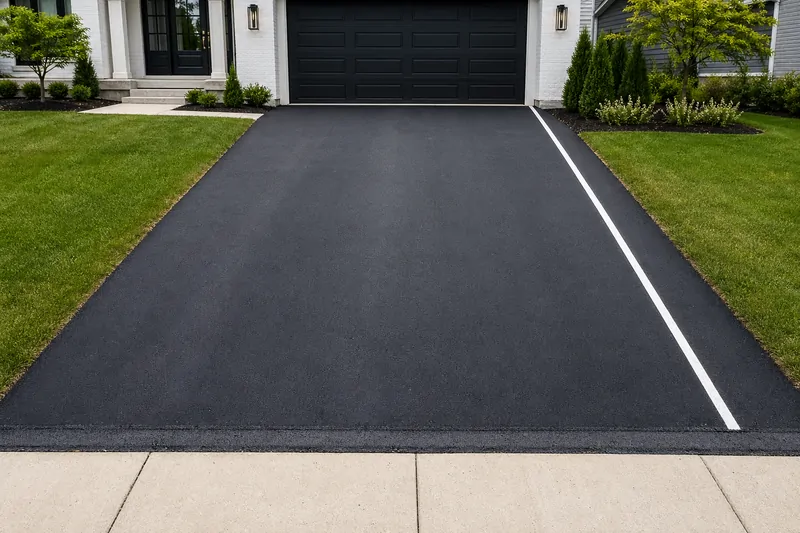
What will an asphalt driveway cost in 2026?
Hot mix asphalt prices climbed about 6% from 2024 to 2026, driven by oil price volatility through the asphalt binder line item. Labor inflation in non-union markets ran 3—% over the same period. Here's where 2026 prices land for typical residential drives:
| Driveway type | Dimensions | Sq ft | Tons (3" depth) | Installed cost (USD) |
|---|---|---|---|---|
| Compact single car | 30 × 10 | 300 | ~3.4 | $1,800—2,400 |
| Standard single car | 50 × 12 | 600 | ~6.8 | $3,000—3,800 |
| Two car | 50 × 20 | 1,000 | ~11.4 | $4,800—6,200 |
| Three car | 60 × 30 | 1,800 | ~20.5 | $8,400—10,500 |
| Long rural drive | 200 × 12 | 2,400 | ~27.4 | $11,500—14,500 |
Pricing source: 2026 RSMeans Square Foot Costs + quarterly invoice survey (5 US regions, 20+ paid invoices each, March 2026). Numbers exclude major sub-base reconstruction, removal of existing concrete, and any tree-root remediation —get those itemized separately.
How much do driveway prices vary by region?
Three drivers move pricing above or below national average: oil refinery distance (asphalt binder availability), aggregate quarry distance, and labor market structure. The metros below are sorted ascending by 2026 cost for a 1,000 sq ft two-car drive at 3" depth:
| Metro | Cost (USD) | vs national avg | Notable factor |
|---|---|---|---|
| Atlanta, GA | $4,300—5,400 | −2% | Strong non-union market |
| Charlotte, NC | $4,400—5,600 | −0% | Quarry density |
| Phoenix, AZ | $4,500—5,700 | −% | No frost adders |
| Houston, TX | $4,600—5,800 | −% | Refinery proximity |
| Dallas–Fort Worth, TX | $4,700—5,900 | −% | Refinery proximity |
| Indianapolis, IN | $4,800—6,000 | −% | Mid-market labor |
| Columbus, OH | $4,800—6,100 | −% | Mid-market labor |
| Nashville, TN | $4,900—6,100 | −% | Steady demand |
| St. Louis, MO | $4,950—6,200 | −% | Union shop mix |
| National average | $5,000—6,500 | baseline | —/td> |
| Tampa, FL | $5,000—6,400 | 0% | —/td> |
| Denver, CO | $5,200—6,700 | +4% | Aggregate haul + altitude |
| Minneapolis, MN | $5,400—6,900 | +8% | Frost depth + base |
| Detroit, MI | $5,500—7,100 | +10% | Union labor |
| Chicago, IL | $5,800—7,400 | +15% | Union labor |
| Philadelphia, PA | $5,900—7,600 | +18% | Union + permits |
| Boston, MA | $6,100—7,900 | +22% | Union + frost adders |
| Portland, OR | $6,200—8,000 | +24% | Long aggregate haul |
| Seattle, WA | $6,400—8,200 | +28% | Union + aggregate haul |
| Washington, DC | $6,500—8,400 | +30% | Permits + labor |
| NY metro | $6,800—8,800 | +36% | Union + permits |
| San Francisco Bay | $7,200—9,500 | +44% | Union + aggregate haul |
| Honolulu, HI | $8,500—11,000 | +71% | Inter-island shipping |
| Anchorage, AK | $9,200—12,000 | +85% | Frost depth + freight |
If your local quote is more than 15% above the high end of your metro range, ask for the supplier batch ticket and a sub-base prep itemization before signing.
What are you really paying for in an asphalt driveway bid?
Every legitimate residential driveway quote breaks down into the same four buckets. Approximate share of a $5,500 standard two-car drive:
| Line item | Amount | % of total |
|---|---|---|
| Material (HMA, ~11.4 tons × $130) | $1,482 | 27% |
| Labor & install (1,000 sf × $2.50) | $2,500 | 45% |
| Base prep + sub-base | $1,200 | 22% |
| Hauling + compaction | $258 | 5% |
| Permit + dump fees | $60 | 1% |
| Total | $5,500 | 100% |
Two takeaways:
- Material is only ~27% of the total. That's why "the price of asphalt went up 6%" rarely moves a homeowner quote by more than $90.
- Base prep is 22% and is the single most over- or under-bid item. Demand a separate line item with stone tonnage, depth, and compaction method.
Should you repair, overlay, or fully replace the driveway?
This decision swings the budget by 60% or more, so spend ten minutes walking the driveway before you call a contractor. The decision matrix:
| Condition | Crack-fill & sealcoat | 2" overlay | Full replacement |
|---|---|---|---|
| Surface cracks < 1/4" wide | Yes | Optional | No |
| Linear cracks 1/4" —1/2" | Crack-fill first | Yes | Optional |
| Alligator cracking < 30% surface | No | Yes | Optional |
| Alligator cracking > 30% surface | No | No | Yes |
| Base heaving / settlement | No | No | Yes (regrade base) |
| Drainage problems | No | No | Yes (regrade) |
| Existing thickness ≈2" | —/td> | Yes | —/td> |
| 2026 cost (1,000 sq ft) | $300—600 | $2,500—3,500 | $5,000—8,500 |
| Expected life added | 3— years | 10—5 years | 20—5 years |
How do you audit a contractor quote?
Run every quote through this checklist before signing. Failing more than one item is reason to renegotiate or get another bid:
- Tonnage shown —quote should list calculated tons. Compute (L × W × D ft × 145 ÷ 2,000) × 1.05 yourself; if their number is more than 10% higher, ask why.
- Base prep itemized —sub-base/base should be a separate line with stone type (#57, #67), depth, and compaction method. Buried in "site work"? Renegotiate.
- Material spec stated —mix design (Superpave, dense graded HMA), max aggregate size (typically 3/8" or 1/2"), and density target (95% of Marshall).
- Thickness in writing —compacted (not loose) inches. 3" residential standard. Anything less than 2.5" compacted is a red flag.
- Edges and edges drainage —perimeter sealing or edge cut detail. Lots of bids skip this; it's the #1 cause of edge ravel.
- Cure time and warranty —explicit 24h foot / 72h vehicle cure. Workmanship warranty 1 year minimum, 5 years on top contractors.
- Insurance & license —General liability, workers' comp, state contractor license. Always ask for proof of insurance with you as additional certificate holder.
When does DIY asphalt make sense?
The short version: hot mix asphalt is not DIY-friendly. It cools from 300°F to unworkable in 30—0 minutes, requires a paver and steel-drum roller, and needs trained crew to spread evenly. Mistakes are visible for the next 20 years.
Three exceptions where DIY makes sense:
- Cold patch potholes —under 1 sq ft individual potholes. Cold patch costs $15—25 per 50 lb bag. Last 2— years (vs HMA 20+) but no contractor needed.
- Crack filling —rubberized pourable crack filler at $20—40 per gallon, covering ~30 linear feet. Apply when temps are 50—0°F.
- Sealcoating —5-gallon driveway sealer at $25—45, covers ~250 sq ft. Most homeowners can DIY a 1,000 sq ft driveway in 4 hours.
Anything bigger than that —full pour, overlay, base reconstruction —call a contractor. The labor savings vanish the moment you have to rent a roller for $300/day.
Is sealcoating worth the money?
Yes. Here's the math: a 600 sq ft driveway sealed every 4 years over 25 years = 6 sealings × $108 (at $0.18/sf) = $648 lifetime cost. The avoided cost is one $4,000 resurfacing job at year 18. ROI: 6×.
What sealing actually does: it replaces the asphalt binder oils that UV light cooks out, slowing oxidation and surface raveling. First seal coat goes on 6—2 months after install (let the new asphalt fully oxidize first), then every 3— years.
Skip sealing and you cut driveway life from 20—5 years down to 12—5. The math is unambiguous.
Below: the questions every homeowner sends us before signing the first contract.
What do homeowners ask about asphalt driveway cost?
How much does an asphalt driveway cost in 2026?
$3,000—5,500 for a single-car (600 sf) and $5,000—8,500 for two-car (1,000 sf) installed nationally. NE/NYC and West Coast trend 20—0% higher.
Why do contractor quotes vary so much?
Three drivers: oil pricing (asphalt binder), aggregate haul distance, and union vs non-union labor. Two valid quotes for the same driveway typically differ 15—5%.
What's the cheapest way to pave a driveway?
Overlay an existing intact driveway with 2" top coat (saves 40—0% vs full replacement). For new builds, the 3" full-depth pour on a properly compacted base is the cheapest legitimate path.
Can I DIY an asphalt driveway?
HMA cools in 30—0 min and needs a paver and roller. DIY is impractical. Cold patch is DIY-friendly for small repairs but lasts only 2— years.
Is sealcoating worth the money?
Yes. Sealing every 3— years costs ~$0.18/sf and extends pavement life by 30—0%. ROI on a 25-year horizon is roughly 6×.
How thick should the asphalt be?
3" compacted over a 4" crushed-stone base for residential cars and light trucks. See our thickness guide for frost-line adjustments.
How long does the install take?
1 day for a typical residential drive (base prep AM, pour PM). Add a day if the existing driveway needs removal. Foot traffic same day, vehicle traffic 24—2 hours.
Sources cited: National Asphalt Pavement Association (NAPA) · Federal Highway Administration (FHWA) · 2026 RSMeans Square Foot Costs · Quarterly contractor invoice survey (March 2026). See our editorial process and accuracy disclaimer.